

Table of Contents
- What Is a Blowout Taper and How Is It Different from a Regular Fade?
- What Does a Blowout Taper Look Like on Curly Hair?
- Which Blowout Taper Is Right for You Low, Mid, or High?
- What Exactly Should You Tell Your Barber?
- How Should Your Barber Cut Curly Hair Differently?
- How Do You Style a Blowout Taper at Home?
- What Products Do You Need for a Blowout Taper on Curly Hair?
- How Long Does a Blowout Taper Last and How Do You Maintain It?
- Does the Blowout Taper Work for Your Hair? (First-Timers and Edge Cases)
- Choosing a Barber Who Actually Knows Curly Hair
- Final Takeaways
What is a blowout taper for curly hair, and who is it best suited for?
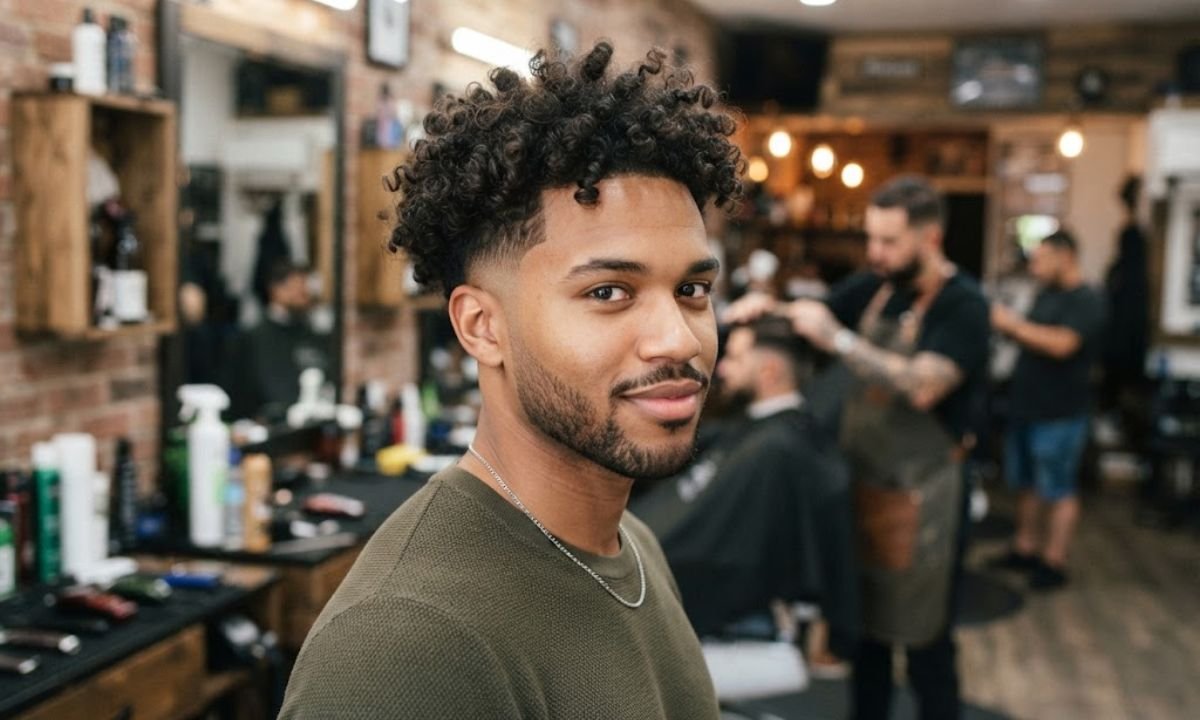
A blowout taper is a haircut where the top stays long and full, almost like a voluminous curly top, while the sides and back shrink down through a precision-tapered fade. Think of it as the meeting point between an afro and a fade.
It works best if you’ve got Type 3 curly hair or Type 4 coily hair and you want your curls to breathe instead of getting boxed in. If you’re tired of a shape that looks flat one day and huge the next, this cut gives you structure without killing your curl pattern.
It also suits guys who want a low-effort routine. You get clean structured sides, so you’re not fighting frizz at your temples every morning, while the top still lets your natural texture do its thing.
What Is a Blowout Taper and How Is It Different from a Regular Fade?
People mix these two up all the time, and honestly, it’s an easy mistake. A regular taper fade usually pairs short sides with a short or medium top, everything staying pretty tight and even.
A blowout taper flips that ratio. The top gets left long and shaped into a rounded, lifted silhouette, almost like it’s “blowing out” from the head, while the sides taper down to skin exposure or close to it. That contrast is the whole point.
You’re not just getting a haircut style, you’re getting visual contrast. Short, tapered temples next to a big, textured crown. It reads as intentional, not messy, and that’s exactly why it’s blown up on social media over the last couple years.
What Does a Blowout Taper Look Like on Curly Hair?
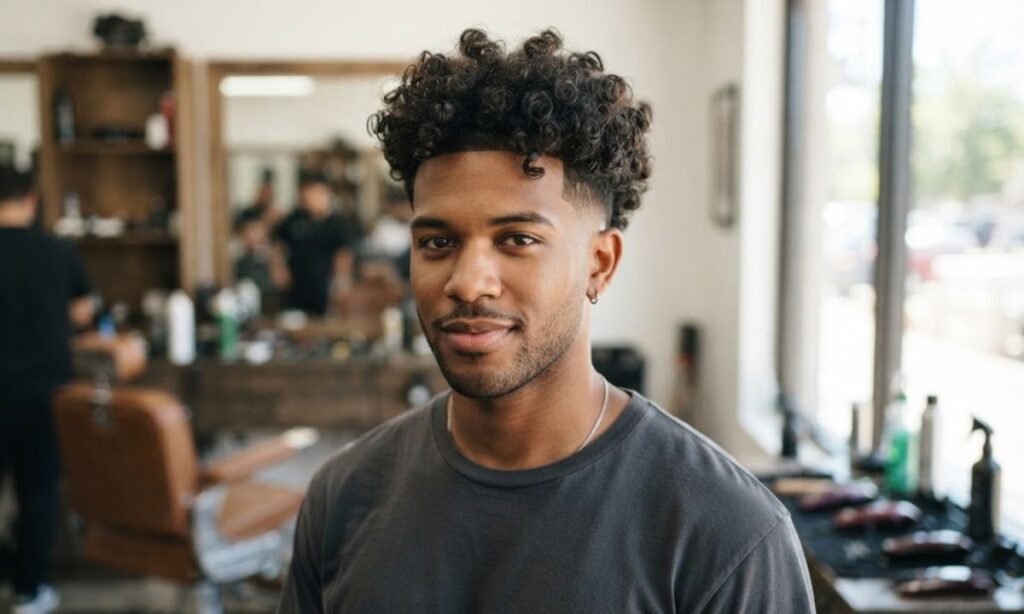
This is where curl type actually matters a lot. Your hair’s natural texture decides how the top sits, how much it shrinks, and how the taper blends into it. Two people can ask for the exact same haircut and walk out with completely different results because their curl pattern isn’t the same.
That’s why so many guys get frustrated after a cut. They showed a photo, the barber nodded, and the final look didn’t match because nobody accounted for how their specific curls behave. Knowing your type before you sit in the chair changes everything.
Type 3 Curly Hair (2c, 3a, 3b, 3c): Defined Curl Rings with Volume

If you’ve got 2c curls, 3a curls, 3b curls, or 3c curls, your hair naturally forms spiral curl rings with visible definition. On a blowout taper, this type usually creates a soft, rounded top with clear curl clumps rather than one solid puff.
The taper on the sides blends into looser strands near the hairline, so your barber needs to work with softer transitions. A harsh, blunt line can look disconnected against loosely coiled curls.
You’ll also notice more wet-to-dry shrinkage with Type 3 hair than people expect. Curls that look shoulder-length wet can bounce up two or three inches once they’re dry, which trips up a lot of first-timers who didn’t plan the length correctly.
Type 4 Coily Hair (4a, 4b, 4c): Afro-Shaped Top with Precision Taper

Type 4 coily hair, covering 4a coils, 4b coils, and 4c coils, tends to shrink the most of any curl type. What looks like four inches of hair stretched out might only measure one and a half inches once it dries and coils back up.
On this hair type, a blowout taper usually results in a more rounded, afro-shaped top, almost like a modern take on a classic afro but with sharp, tapered sides underneath it. That combination is where the “precision” part of precision-tapered fade really earns its name.
Because coily strands are more fragile at the root, your barber needs a gentler touch and sharper tools. A dull blade or rushed technique causes more breakage on Type 4 hair than on straighter textures, so this isn’t a cut to rush.
Which Blowout Taper Is Right for You Low, Mid, or High?
Taper height decides where the shortest point of your fade sits, and it changes the whole personality of the haircut. A low taper starts just above the ears, keeping most of your sides fuller and closer to your natural hairline.
A mid taper climbs a bit higher, usually to around temple level, giving you more contrast without going too dramatic. It’s the safest middle ground if you’re not sure what you want yet.
A high taper pushes the shortest point up near the crown, creating the boldest visual contrast between your voluminous curly top and your clean structured sides. It’s sharper, more attention-grabbing, and honestly less forgiving if you’re new to short sides.
- Low taper: subtle, office-friendly, great for a first cut
- Mid taper: balanced, works with most face shapes
- High taper: bold, best if you already like shorter sides
Does Head Shape Affect Which Taper Height Works Best?
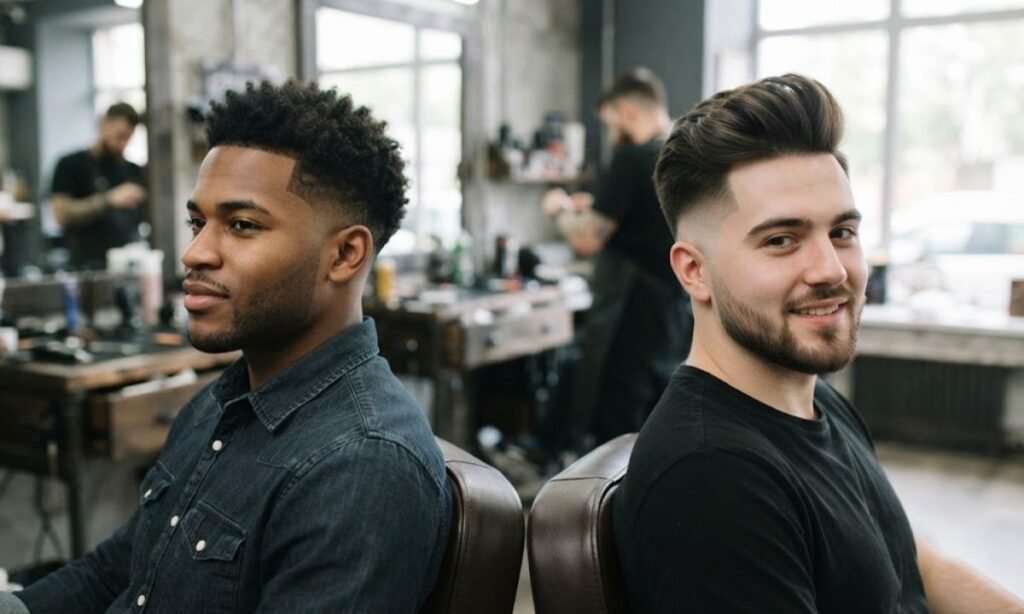
Yes, and this gets skipped in most conversations about this haircut. If you’ve got a rounder head shape, a higher taper adds length and structure, making your face look a little more angular.
If your head shape is naturally longer or narrower, a low or mid taper usually looks more balanced. Going too high can stretch your face shape further and make things look disproportionate.
A good barber will glance at your head shape before recommending a height. If yours doesn’t, it’s worth asking directly, because this one decision affects how the entire cut sits on your face.
What Exactly Should You Tell Your Barber?
This is the part where most curly haircuts go wrong, and it’s rarely the barber’s fault entirely. Vague instructions like “just taper it” leave way too much open to interpretation, especially with curly or coily hair.
You need to give specific, measurable direction. Not vibes, actual numbers and reference points your barber can work from.
The Shrinkage Problem: Why Curly Hair Requires Different Instruction

Here’s the thing nobody explains well: curly hair shrinkage means the length you see isn’t the length you’re getting cut. If you tell a barber “leave three inches on top” while your hair is wet, you could end up with something way shorter than you pictured once it dries and coils up.
That’s why experienced curl cutters talk about stretched inches instead of visible length. They’ll pull a section straight, measure it while stretched, and cut based on that number, not what it looks like curled up in a wet clump.
If your barber doesn’t bring this up, bring it up yourself. Ask them to measure hair while stretched rather than guessing off wet volume, especially if you’ve got Type 4 coils where shrinkage can hit 70% or more.
Ready-to-Use Barber Scripts (Copy or Screenshot These)
Walking in with the right words saves you an awkward, disappointing appointment. Here are scripts you can literally read off your phone.
For a low blowout taper: “I want a low taper on the sides, blending into skin near my ear, with the top left long for a voluminous curly top. Please cut the top dry and measure hair while stretched, not wet.”
For a mid blowout taper: “Give me a mid taper, starting around my temple, with a soft natural line where it meets my curls. Keep the top full, and please point-cut the top instead of blunt cutting so it doesn’t look boxy.”
For a high blowout taper: “I’d like a high taper, tight up near the crown, for maximum contrast against my curls on top. Since I’ve got Type 4 hair, please account for shrinkage and don’t over-cut the length.”
Bring two or three reference photos too, ideally of people with a similar curl pattern to yours, not just a random photo off Pinterest with straight hair styled to look wavy.
How Should Your Barber Cut Curly Hair Differently?
Curly and coily hair doesn’t behave like straight hair under scissors or clippers, and a barber who treats it the same way usually delivers a cut that looks wrong within a week. The technique matters as much as the style you ask for.
Point Cutting vs. Blunt Cutting on Curly Hair
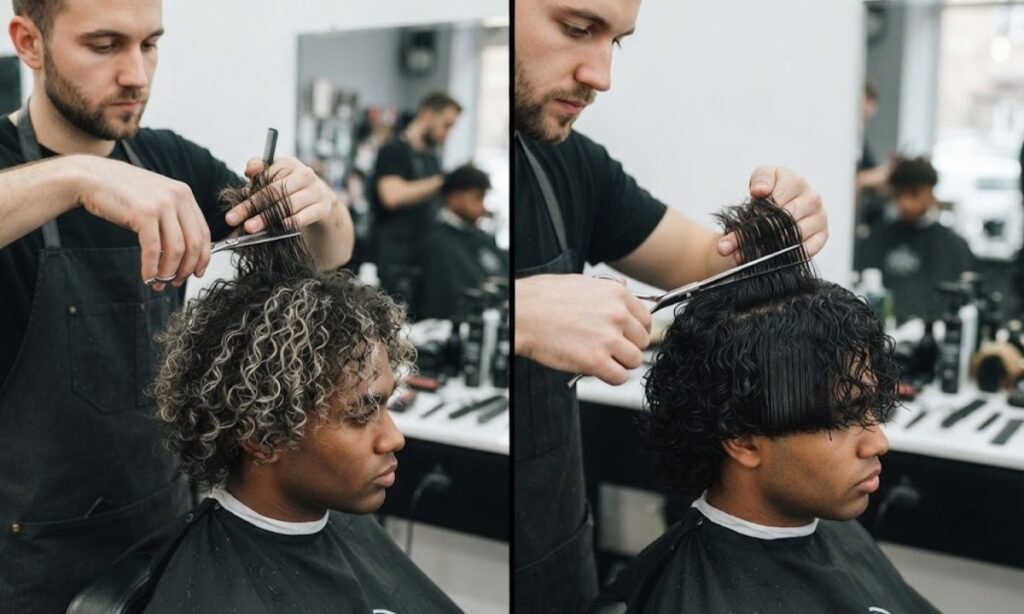
Blunt-cut the top and you get a heavy, boxy shape that fights against your natural curl pattern. It might look fine the day of the cut, but as curls settle, blunt ends create weight that pulls definition downward instead of letting curls bounce.
Point cutting works differently. The barber cuts into the ends at an angle, which helps with curl separation and lets individual curl rings show instead of clumping into one dense shape.
This technique also helps remove bulk without shortening the overall length too aggressively. It’s the difference between a top that looks sculpted and one that looks like it’s wearing a helmet.
Why the Fade Line Matters More on Coily Hair
On straight or wavy hair, a slightly imperfect fade line is forgiving because the hair falls flat and hides small mistakes. On coily hair, every strand pushes outward, so any unevenness in the fade line becomes obvious fast.
This is where sharp line-up work becomes non-negotiable. The edge where your tapered sides and neckline meet your natural growth needs to be crisp, or the whole cut reads as sloppy no matter how good the top looks.
A skilled barber will also think about natural grow-out. Coily hair grows outward more than downward, so a fade that looks perfect on day one can look uneven by week two if the barber didn’t plan for that growth pattern.
How Do You Style a Blowout Taper at Home?
Getting the cut is half the job. Styling it right is what makes people ask where you got your hair done. Your routine depends heavily on which curl type you’re working with.
Type 3 Curly Hair Styling Routine (Step-by-Step)
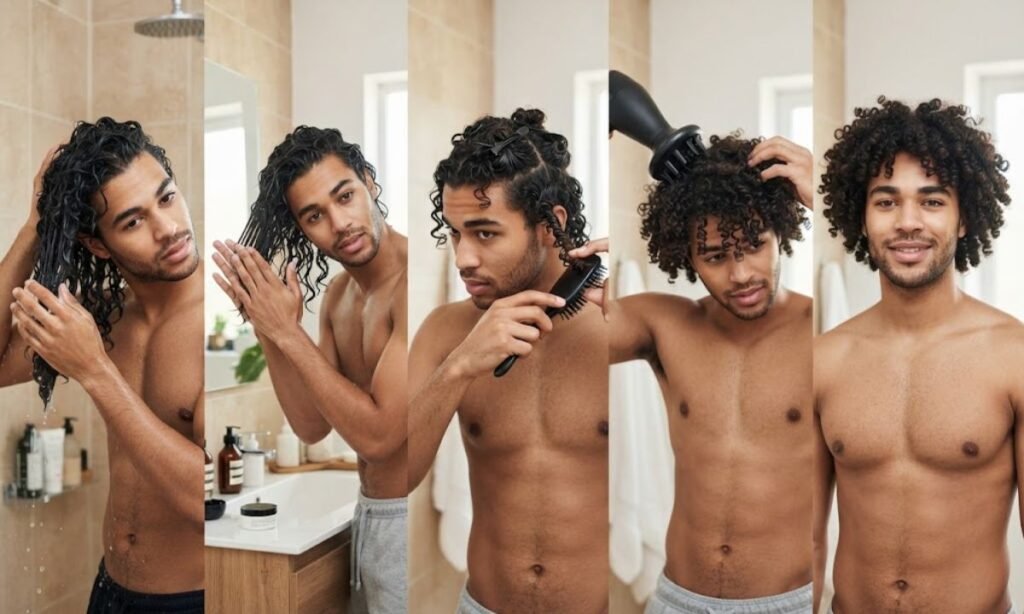
- Start with a sulfate-free shampoo or a co-wash, since regular shampoo strips moisture your curls need.
- Apply a leave-in conditioner on soaking wet hair, working it through section by section.
- Add a curl cream for definition, scrunching upward instead of pulling down.
- Use a diffuser attachment on low heat, cupping curls close to your scalp for vertical lift.
- Once mostly dry, switch to cool air to lock the shape in and cut down on frizz.
Don’t touch your curls too much while they’re drying. Every time you run your fingers through wet curls, you’re breaking clumps apart and inviting frizz control problems later.
Type 4 Coily Hair Styling Routine (Step-by-Step)
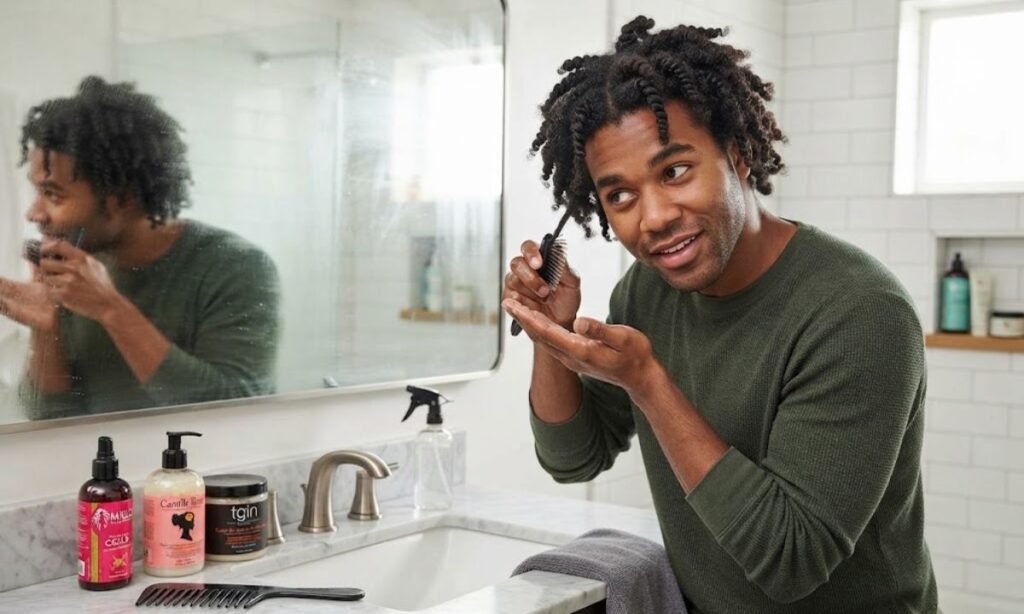
- Detangle gently with a curl sponge or wide-tooth comb on wet, conditioned hair.
- Apply a curl activator for moisture and hold, since Type 4 hair dries out faster than looser textures.
- Use a small amount of curl mousse on top for structure without weighing the roots down.
- Diffuse with medium airflow, lifting from underneath to build crown volume.
- Finish with an afro pick to lift roots and shape the overall silhouette.
Watch out for crown weight. Too much product up top can flatten your volume instead of enhancing it, so start light and build up if you need more hold.
How to Refresh Your Curls on Day 2 and Day 3
You don’t need to wash daily to get a curl refresh. A light mist of water mixed with a bit of leave-in conditioner can rehydrate curls that have gone flat or frizzy overnight.
To reshape curls, scrunch upward with damp hands, then add a small amount of curl cream or mousse to spots that need extra definition. This works especially well by day two.
Sleeping on a satin pillowcase or silk pillowcase genuinely changes how your curls look the next morning. Cotton pulls moisture out and causes friction, both of which wreck curl definition overnight.
What Products Do You Need for a Blowout Taper on Curly Hair?
You don’t need twenty products crowding your bathroom shelf. A focused routine with the right basics beats a cluttered one every time.
- Sulfate-free shampoo: cleans without stripping your curls dry
- Leave-in conditioner: your moisture foundation, applied every wash day
- Curl cream: for definition and light hold on looser curl patterns
- Curl mousse: adds volume without heaviness, especially useful on top
- Curl activator: hydration and shape, particularly good for Type 4 coils
- Heat protectant: non-negotiable before any diffuser or blow dryer use
- Diffuser attachment: shapes curls while drying instead of blowing them straight
- Afro pick: lifts roots for volume on coilier textures
- Curl sponge: helps define coils and manage shrinkage during styling
Skip anything with heavy silicones if you’re not using sulfate shampoo regularly, since they build up fast and leave curls looking dull instead of defined.
How Long Does a Blowout Taper Last and How Do You Maintain It?
The top of a blowout taper grows out gracefully since length just adds more volume over time. The sides are a different story, and this is where a consistent maintenance schedule matters most.
Most guys need to revisit the barbershop every two to three weeks to keep the tapered temples and fade line sharp. Wait too long, and the contrast that makes this cut work starts to blur into an uneven, grown-out mess.
If you want to stretch time between barbershop visits, ask your barber for a slightly higher starting point on the fade. It buys you an extra week or so before the line-up looks like it needs a refresh.
- Every 2 to 3 weeks: full fade and line-up refresh
- Every 6 to 8 weeks: consider a top trim to manage shape and bulk
- Weekly: deep condition to keep curls healthy between cuts
Does the Blowout Taper Work for Your Hair? (First-Timers and Edge Cases)
Almost anyone with curly or coily hair can pull off some version of this cut, but a few things determine how well it’ll suit you and how smooth your first experience will be.
Getting Your First Blowout Taper on Curly Hair
Go in with damp, unstyled hair if possible, not freshly washed and puffed up. Your barber needs to see your natural curl pattern to plan the cut accurately, and overly styled hair hides that.
Bring your reference photos, use the scripts above, and don’t be afraid to ask questions mid-cut. A good barber won’t mind explaining why they’re cutting dry instead of wet, or why they’re going slower on your crown.
Expect your first cut to feel shorter than photos suggested, especially if you’ve got significant shrinkage. That’s normal, and it usually settles into the shape you wanted within a wash or two as curls fully spring back.
Common Mistakes to Avoid
- Asking for a specific length without mentioning shrinkage, which almost guarantees disappointment
- Letting a barber blunt-cut the top when point cutting suits curls better
- Skipping heat protectant before diffusing, which damages curls over time
- Waiting too long between barbershop visits, letting the fade grow out unevenly
- Using heavy, silicone-based products without clarifying regularly, causing buildup and dullness
- Going in with hair fully styled instead of natural, hiding your real curl pattern from your barber
Choosing a Barber Who Actually Knows Curly Hair
Not every barber has real experience with curly hair technique, and that’s fine to admit, but it’s on you to find out before you sit down. Ask directly if they regularly cut Type 3 or Type 4 hair, and look at their portfolio for textures similar to yours.
A barber who specializes in curly haircut and coily haircut work will usually mention dry cutting, shrinkage, or point cutting without you having to bring it up first. That’s a good sign they understand curly hair technique beyond a generic taper haircut.
Don’t be shy about walking through your barber instructions together before they pick up any tools. A five-minute conversation upfront saves you a disappointing cut and an awkward wait for it to grow out.
You can also checkout this article as well Curly Burst Fade Haircut: 37 Styles for Every Curl Type (2026)
Final Takeaways
A blowout taper for curly or coily hair comes down to three things: knowing your curl type, communicating clearly, and finding a barber who respects how curls actually behave. Skip any one of those, and the cut won’t hold up.
Whether you land on a low taper, mid taper, or high taper, the goal is the same, clean structured sides paired with a top that celebrates your natural texture instead of fighting it. Use the scripts, bring your photos, and don’t settle for “just taper it.”
Your curls did all this shrinking, springing, and coiling long before you walked into a barbershop. Give a barber the right information, and they can finally work with that texture instead of against it.
