

A high taper fade for curly hair is a cut where the sides and back shrink down to skin or near skin high on the head, right around the temple. The curls on top stay long enough to keep their shape, bounce, and weight.
It works on every curl type from 2B wavy hair to 4C hair, as long as your barber plans for shrinkage.
You probably have questions before you book. Will it look sharp or will it look like a bowl? Will your curls collapse once the sides come off?
This guide answers those, step by step, with real numbers, product picks, and a word-for-word barber script.
What is a high taper fade for curly hair?

Think of it as a clean frame around a full picture. The curly taper fade removes bulk from the sides and back, then lets your curls take center stage on top.
The fade starts high, so the contrast between the skin and the curls is bold and obvious.
Here’s the part most people miss. The sides don’t just get shorter, they get shorter in a gradient.
Hair near the top of the sides keeps some length, while hair near the ears and neckline drops to a number one guard or a near-skin fade.
On curly hair this matters more than on straight hair. Curls bounce back up after cutting, so a rough blend looks even rougher.
A well done high taper fade for curly hair men wear daily looks tidy from every angle, even when the top is messy.
What Is a High Taper Fade?
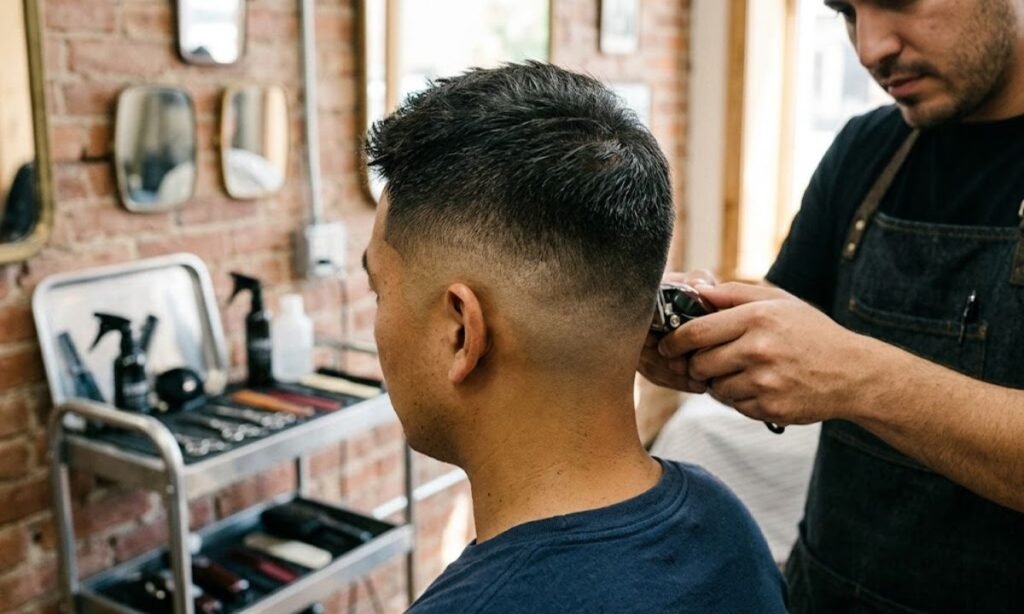
A high taper fade (also called a high fade haircut or high taper haircut) begins its shortest section high on the head. That usually means around the temple, above the ear, and a couple of inches above the neckline.
The fade then climbs toward the top of the head until it meets the longer hair.
People often ask, where does a high taper fade begin? The answer is the upper edge of the sideburn area, close to the temple.
If you can draw an imaginary line from your eyebrow tail back toward the crown, the fade starting point sits at or just above that line.
Now, a quick word on the difference between a taper and a fade. A taper gets gradually shorter, but it usually leaves some length at the shortest point.
A fade drops all the way to skin. A high taper fade mixes both ideas, so you get a clean gradient plus a sharp skin fade or near-skin fade around the ears and neck.
Here’s a simple picture to keep in mind:
- High placement: the blend starts near the temple
- Strong contrast: short sides against fuller curls on top
- Clean edges: many guys add a line-up at the front and around the ears
- Flexible finish: you can go skin tight or leave a soft #1 shadow
Does a High Taper Fade Work on Curly Hair?
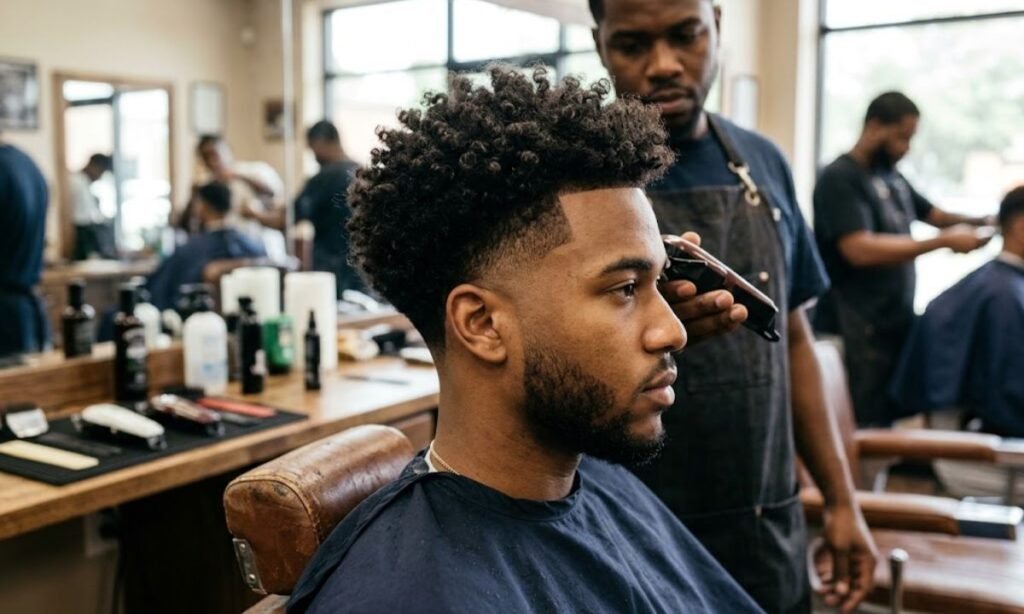
Yes, and often better than on straight hair. Curls have natural volume, so removing the sides makes the top look even fuller.
That contrast is why a high taper fade for curly hair shows up in barbershop mirrors so often.
So does a high taper fade work on curly hair of every type? In most cases it does, though the best version changes with your curl pattern.
Tighter coils hold the shape of the fade longer, while looser waves need a bit more length on top to avoid puffing out.
There’s one big catch: curl shrinkage. Curly hair looks much shorter when it dries than it does when it’s stretched or wet.
If your barber ignores that, you’ll walk out with a cut that’s far shorter than you pictured.
Picture a guy named Dre who asks for “two inches on top.” His barber measures while the curls are pulled straight.
Two hours later his hair has bounced up to under an inch, and he’s staring at his reflection wondering what went wrong. We’ll fix that mistake in a later section.
Here’s a quick answer for the does a high taper fade change your curl pattern crowd. It doesn’t. Your curl pattern is set at the root by genetics, not by clippers.
What changes is how your curls sit, because less weight around the sides lets them lift and spring more.
High Taper Fade for All Curl Patterns
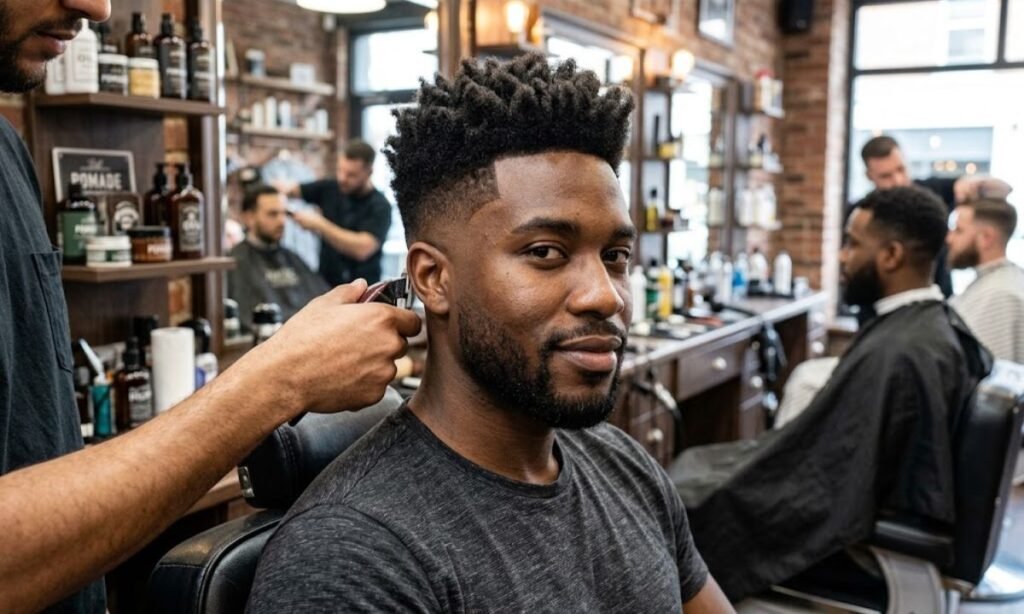
Curl types run from loose waves to tight zigzag coils. A high taper fade for all curl patterns is possible, but the plan for each type shifts a little.
Use the breakdown below as a starting point, then adjust with your barber.
High Taper Fade for 2B Wavy Hair
2B wavy hair forms loose S shapes that start mid-length. Shrinkage is low, so you only lose around a quarter inch or so.
Leave about 3 to 4 inches on top and ask for a wavy textured top so it doesn’t lie flat.
High Taper Fade for 2C Hair
2C hair has deeper waves that sometimes tighten into loose curls near the ends. It shrinks a bit more than 2B, but it’s still forgiving.
A textured crop or curly fringe looks great here, with about 3 inches on top.
High Taper Fade for 3A Curls
3A curls make clear, springy loops about the size of a thick marker. They show curl definition easily when you use a light cream or mousse.
Keep 3 inches or more up top so the loops can form, and a curly quiff or side-swept curls both work well.
High Taper Fade for 3B Curls
3B curls are tighter spirals, close to the width of a pencil or a finger. They shrink noticeably, often by 40 to 50 percent.
Plan on 3 to 4 inches stretched if you want about 2 inches after drying, and give your defined ringlets room to breathe.
High Taper Fade for 3C Hair
3C hair packs tiny corkscrews close together, so density is high. A high taper fade for 3C hair removes bulk from the sides and makes the top look intentional.
This is where sponge curls and a rounded coil top shine.
High Taper Fade for 4A Coils
4A coils form small, springy S shapes with clear definition. Shrinkage can reach 60 percent when dry.
A short curly top or dense coil crown looks best, and a high taper fade with line-up adds a sharp edge.
High Taper Fade for 4B Hair
4B hair bends in a zigzag instead of a clear curl. It reads as softer and denser, and shrinkage often runs 60 to 70 percent.
A high taper fade for 4B hair pairs nicely with a rounded coil top or finger coils.
High Taper Fade for 4C Hair
4C hair is the tightest pattern and the one that shrinks most. Some people lose up to 75 percent of their length when it dries.
A high taper fade with 4C hair can look incredible, especially with a clean hard part or near-skin fade.
High Taper Fade for Kinky Coily Hair and Black Men with Curly Hair
People use kinky hair and coily hair to describe the tight end of the curl scale. A high taper fade for kinky coily hair is a staple in many barbershops.
A high taper fade for Black men with curly hair also works as a polished, professional look that’s easy to keep up.
How to Calculate Curly Hair Shrinkage
This step saves more haircuts than any product ever will. Shrinkage percentage is how much shorter your hair gets when it dries and the curls spring back.
Here’s how to calculate curly hair shrinkage at home in a couple of minutes.
- Step 1: Wet a small section near the front and pull it straight.
- Step 2: Measure that stretched length with a ruler.
- Step 3: Let it dry fully without touching it.
- Step 4: Measure again, then subtract the dry number from the stretched number and divide by the stretched number.
Say your stretched section measures 4 inches and the dry curl springs back to 2 inches. That means 50 percent curl shrinkage.
You now know the real number to tell your barber.
This is also how you get two inches of dry length after shrinkage. If you shrink by 50 percent, you need about 4 inches of stretched hair length.
If you shrink by 70 percent, like many 4C heads do, you’d need over 6 inches. That’s why curly hair shrinkage adjustment matters so much.
So, how long should 4C hair be for a high taper fade? A good starting point is around 4 to 6 inches of stretched length on top for a roughly 2 inch dry look.
Your own shrinkage will tell you the exact answer, so measure first.
Will a High Taper Fade Suit My Face Shape?
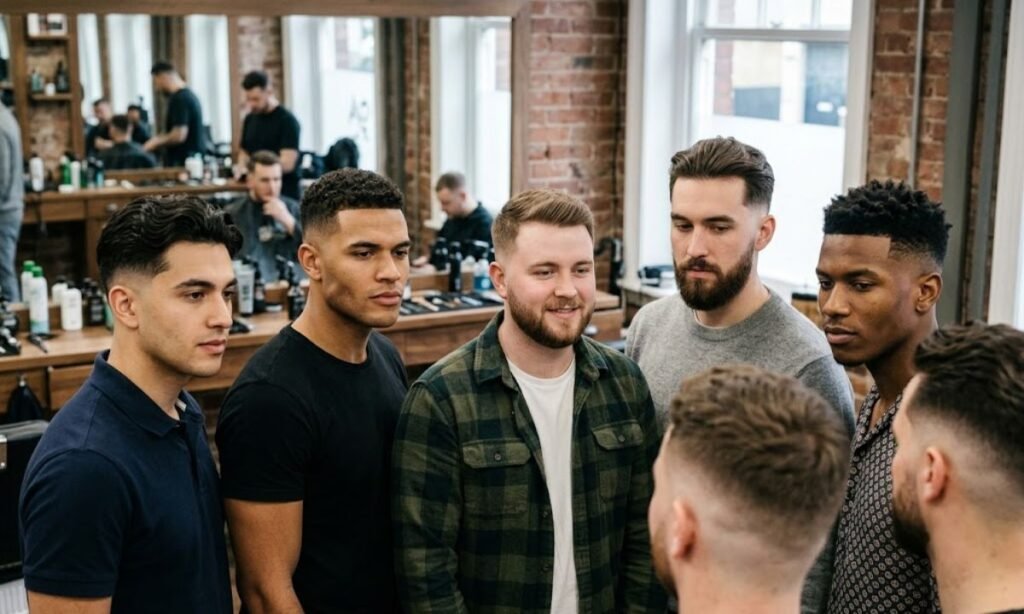
The fade is only half of the story, because the top you pair with it frames your face. Facial geometry decides what looks balanced.
Look at your jawline structure, forehead width, and hairline shape before you pick a style.
Here’s a basic method for how to choose a high taper fade for your face shape. Pull your hair back and look in the mirror. Notice if your face looks longer than it is wide, or if your jaw is the widest part.
That tells you whether you want height, width, or softer edges.
Another detail is vertical elongation. A taller top makes the face look longer, which helps a round face and hurts a long face.
Keep that in mind as you read the sections below.
High Taper Fade for Round Faces
A round face has similar width and length with soft cheeks. You want height, not width.
The best haircut for curly hair and a round face is a high taper fade with a curly pompadour or curly quiff, which adds length and angles.
High Taper Fade for Oval Faces
Oval is the most flexible shape, so nearly any style looks fine. The best curly hairstyle for an oval face depends on your taste.
A curly fringe, messy textured top, or side-swept curls all keep things balanced.
High Taper Fade for Square Faces
Square faces have a strong jaw and a wide forehead. You don’t need extra angles, so softer curls help.
The best taper fade for a square face is a high taper fade with a rounded coil top or loose ringlets, which soften the edges.
High Taper Fade for Diamond Faces
Diamond faces are wide at the cheekbones and narrow at the forehead and chin. The goal is to add width up top.
The best curly haircut for a diamond face is a curly fringe or textured crop with full sides on top, which balances the narrow forehead.
High Taper Fade for Heart-Shaped Faces
Heart shapes have a wide forehead and a narrow chin. You want less volume up top and more weight near the jaw.
The best taper fade for a heart-shaped face is a short curly top or side-swept curls, which keeps the forehead from looking huge.
25 High Taper Fade Styles for Curly Hair

Here are the best high taper fade styles for curly hair. Each one comes with a quick note on who it suits and how to ask for it.
Skim, screenshot a few, and take them to your barber.
1. High Taper Fade with Natural Curls
This is the simplest version. The sides fade high and the top is left in its natural shape.
It suits almost everybody and takes the least effort in the morning.
2. High Taper Fade with Defined Ringlets
You keep about 3 to 4 inches on top and use cream or gel to form clear spirals.
It looks best on 3A and 3B hair, and it photographs beautifully.
3. High Taper Fade with a Wavy Textured Top
This fits 2B wavy hair and 2C hair. Your barber adds texture with a razor or thinning shears so the waves don’t stack flat.
A little sea salt spray brings out the movement.
4. High Taper Fade with Curly Fringe
The front falls over the forehead in loose curls while the sides stay tight.
It helps hide a high forehead and works well on diamond faces.
5. High Taper Fade with Curly Pompadour
The front sweeps up and back with volume, and the fade makes the height look even taller.
A curly pompadour needs strong hold and a bit of patience with the diffuser.
6. High Taper Fade with Textured Crop
This style keeps the top short, around 2 inches, with a choppy finish.
It’s a great pick if you want something low maintenance and a bit edgy.
7. High Taper Fade with Curly Quiff
The front lifts and curves up while the sides fade out neatly.
A curly quiff brings classic style to modern curls, and it works best on round faces.
8. High Taper Fade with Sponge Curls
You use a sponge to twist small coils into the top for a dotted, textured look.
It fits 3C to 4C hair and looks fresh with a skin fade.
9. High Taper Fade with Finger Coils
You twirl small sections around a finger, and the coil sets as it dries.
The result is clean, defined spirals that last for days when you protect them at night.
10. High Taper Fade with Loose Ringlets
This is a softer, relaxed version of the defined look. You skip heavy gel and let the curls fall freely.
It works well for square faces and for a casual, easy feel.
11. High Taper Fade with Side-Swept Curls
The curls sweep to one side, which creates asymmetry and movement.
It flatters heart-shaped and oval faces, and a side part gives it a polished edge.
12. High Taper Fade with Dense Coil Crown
The top is packed with tight coils that form a round, full crown.
With a high fade, the contrast makes the dense coil crown look sculpted.
13. High Taper Fade with Messy Textured Top
You rough up the curls with texture spray and skip any neat styling.
It looks effortless, though your barber still has to cut it carefully to get that “I woke up like this” feel.
14. High Taper Fade with Curly Mohawk
The sides are faded high and tight, leaving a strip of curls through the center.
It makes a bold statement, so it suits guys who want to stand out.
15. High Taper Fade with Short Curly Top
The top stays around 1 to 2 inches, so it’s quick to style and hard to mess up.
A short curly top pairs well with a number one guard on the sides.
16. High Taper Fade with Long Curly Top
Here, the top grows to 5 inches or more, and the curls fall or stack as they like.
The fade keeps the sides tidy so the length looks deliberate instead of shaggy.
17. High Taper Fade with Hard Part
Your barber shaves a clean line into the hair, usually on the side.
It adds sharpness and gives the whole cut a barbershop edge.
18. High Taper Fade with Curly Fringe and Line-Up
This combo mixes a soft, curly front with crisp edges around the forehead and temples.
The contrast between soft curls and a sharp line-up grabs attention.
19. High Taper Fade with Rounded Coil Top
The top is shaped into a smooth dome of coils.
It works on 4A, 4B, and 4C hair, and it makes square faces look softer.
20. High Taper Fade for Maximum Contrast
Go skin tight on the sides and keep the top full.
This high-contrast haircut makes curls pop, though it grows out faster.
21. High Taper Fade for Volume and Definition
You keep a touch more length on top and use a curl cream or custard.
The fade removes side weight, so your curls spring up and show their pattern.
22. High Taper Fade with a Clean Skin Finish
The shortest part of the fade goes all the way to bare skin, which looks super sharp.
It needs more frequent visits, but it’s the cleanest look you can get.
23. High Taper Fade with a Number One Guard
Instead of going to skin, the barber stops at a #1 guard.
It looks softer, hides skin irritation, and costs you a little less upkeep.
24. High Taper Fade with a Near-Skin Finish
This sits between the two options above. Your barber uses a half guard or bare blade to leave a light shadow.
It hides patchiness better than a pure skin fade.
25. High Taper Fade for a Professional Appearance
Keep the top medium length, the sides neat, and the product light.
It looks sharp in an office, and it stays easy to style before work.
How Do You Style a High Taper Fade with Curly Hair?

A good cut gets you halfway, and your routine does the rest. The goal is to hold moisture, shape the curls, and avoid frizz.
Here’s a high taper fade styling guide you can follow in about ten minutes.
Step by Step Routine
Start on wet hair right after you get out of the shower. Curls take product best when they’re soaking, not towel dried to death.
That’s the secret behind how to style curls after a haircut without frizz.
- Step 1: Apply a leave-in conditioner from root to tip. Use about a quarter sized amount for a short top.
- Step 2: Add a curl cream or curl-defining cream. Rake it through, then scrunch upward.
- Step 3: Finish with a light curl mousse or gel for hold.
- Step 4: Dry with a diffuser or let your hair air dry.
That covers how to apply leave-in conditioner to curly hair. Divide your top into sections if you have a lot of hair, and give each part a quick glaze.
For how to apply curl cream without frizz, use soaking wet hair and don’t touch the curls while they dry.
How to Use a Diffuser on Curly Hair
A diffuser spreads air so your curls dry without blowing apart. Set it on low heat and medium speed.
Cup the curls in the bowl, hold for a minute, then move to a new section.
So how long to diffuse curly hair? For a short top, about 8 to 12 minutes usually does it. Longer curls may need 15 to 20.
The key is to stop at around 80 to 90 percent dry.
Here’s why you should stop diffusing at 80 to 90 percent dry. If you dry the curls fully while touching them, the cuticle roughens and frizz appears.
Let the last 10 to 20 percent finish by air drying, and your curl clumping stays intact.
That’s also the answer to why curls lose definition after diffusing. Too much heat, too much touching, or drying all the way through usually does it.
To prevent frizz when diffusing curls, use low-heat diffusing, hands off, and a gentle scrunch at the end.
What Products Work Best for This Cut?
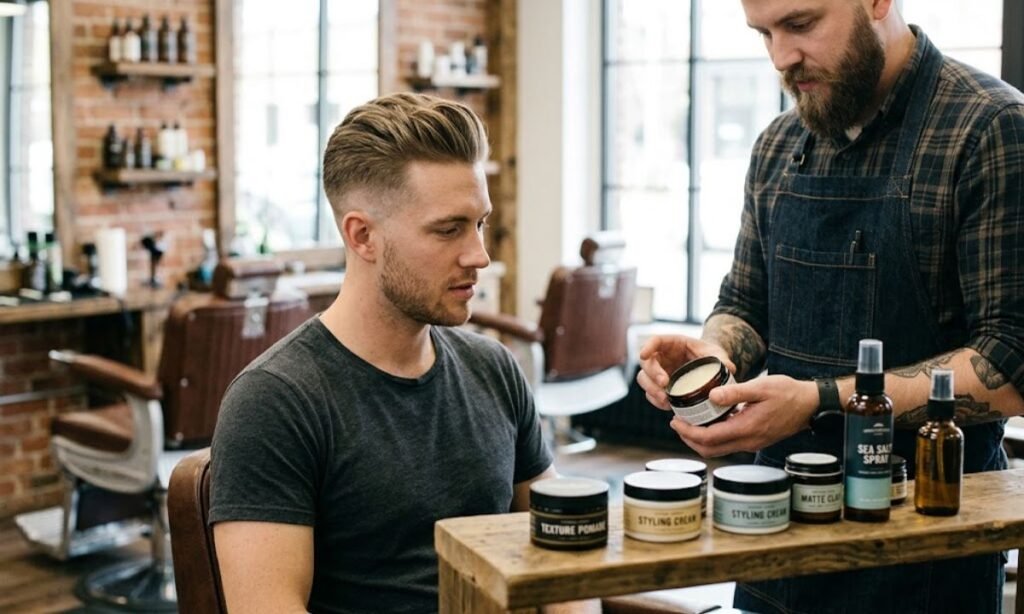
Products decide whether your curls look defined or dry. The right pick depends on your curl pattern and your hair porosity.
A heavy butter that saves 4C hair can flatten 2B waves in a single morning.
Here’s a quick way to match them. Low porosity hair repels water, so it likes light formulas. High porosity hair drinks everything and loses it fast, so it likes richer ones.
If you’re unsure, drop a clean strand into a glass of water and watch whether it floats or sinks after a few minutes.
Best Curl Products for 2B and 2C Hair
Waves get weighed down easily, so keep things light. A lightweight mousse and a little sea salt spray give shape without crunch.
Use a thin leave-in conditioner underneath for moisture, and skip heavy butters.
Best Products for 3A and 3B Curls
This range loves a curl cream or curl-defining cream paired with a gel. The cream hydrates and the gel locks the spiral in place.
A curl activator gel works well too, and a curl-defining custard gives extra clump on thick hair.
Best Products for 3C and 4A Coils
Tighter coils want more slip and more moisture. A thick leave-in conditioner followed by a curl butter keeps strands soft and stretchy.
Seal the top with a few drops of jojoba oil to lock moisture in.
Best Products for 4B and 4C Hair
This hair loses moisture quickly, so layering is key. Start with water, then a creamy leave-in, then an oil or butter on top.
A touch of castor oil helps seal ends, and an anti-frizz serum keeps the edges neat around the fade.
How to Handle Low and High Porosity
Low porosity hair needs light products and a bit of warm water so the hair cuticle opens slightly. Use small amounts, because heavy layers just sit on top.
That’s the answer to how to maintain low-porosity curly hair without buildup.
High porosity hair has gaps in the cuticle, so moisture escapes. Rich creams, butters, and a sealing oil help hold hydration in.
That’s your best products for high-porosity curly hair plan, and it also supports hair breakage prevention.
Product Buildup
If your curls feel coated, dull, or limp, you’ve probably got hair product buildup. It shows up faster on a fade because there’s less hair to absorb everything.
A clarifying shampoo once every two to four weeks resets the scalp and the curls.
What Should You Tell Your Barber?

This is where a good cut is won or lost. A barber can’t read your mind, and “high taper” means different things to different people.
A short barber consultation before the clippers come out saves you weeks of regret.
Here’s a simple high taper fade barber script you can steal. Adjust the numbers to match your own hair.
Say it out loud before you go, so it feels natural in the chair.
- “I’d like a high taper fade that starts at my temple and blends down to a number one guard at the neckline.”
- “My curls shrink about 50 percent, so please leave about 4 inches stretched on top.”
- “Can you cut the top dry so you can see how the curls fall?”
- “Please keep the line-up soft and leave my natural hairline shape.”
- “Here’s a reference photo of the finish I want.”
That covers how to ask a barber for a high taper fade and what to tell your barber about curly hair. The shrinkage mention is the most important line, so don’t skip it.
If your barber nods and asks follow up questions, that’s a good sign.
How Much Length to Leave on Top
People always ask how much length to leave on top for curly hair. A decent rule is to take your desired dry length and divide it by one minus your shrinkage.
For example, a 2 inch dry look with 50 percent shrinkage needs 4 inches stretched.
Should Curly Hair Be Cut Wet or Dry?
Here’s the debate behind should curly hair be cut wet or dry. Wet hair stretches, so you can’t judge the real length or the final shape.
That’s why curly hair should be cut dry for fades, because the barber sees each curl in its true spot.
The same logic explains how wet cutting affects curl length. Hair that looks fine wet can spring up much shorter than expected once it dries.
Dry cutting also helps your barber spot uneven density, so the taper blends cleanly. Many pros use a clipper-over-comb technique on dry curls to keep control.
How to Find a Barber for Curly Hair
Not every shop knows curls. A curly hair barber or curly hair specialist understands shrinkage, density, and how curls behave after a cut.
Check their Instagram or portfolio for curly clients, and ask friends with your curl pattern who they trust.
Here’s what to look for in a curly hair barber:
- Portfolio proof: clear photos of fades on 4A, 4B, or 3C hair if that’s yours
- Dry cutting comfort: they don’t insist on spraying everything soaking wet
- Good questions: they ask about your routine, your shrinkage, and your goals
- Clipper control: smooth blending with no patchy lines or harsh steps
How to Choose a Reference Photo
A photo says more than ten minutes of talking. Pick one that matches your curl pattern, your length, and your face shape guide result.
That’s the answer to how to choose a high taper fade reference photo that actually helps.
Save two or three angles if you can: front, side, and back. Point out what you like, such as the high fade placement or the soft line-up.
Also say what you don’t want, because that clears up confusion quickly.
How Is a High-Taper Fade Different from a Mid- or Low-Taper Fade?
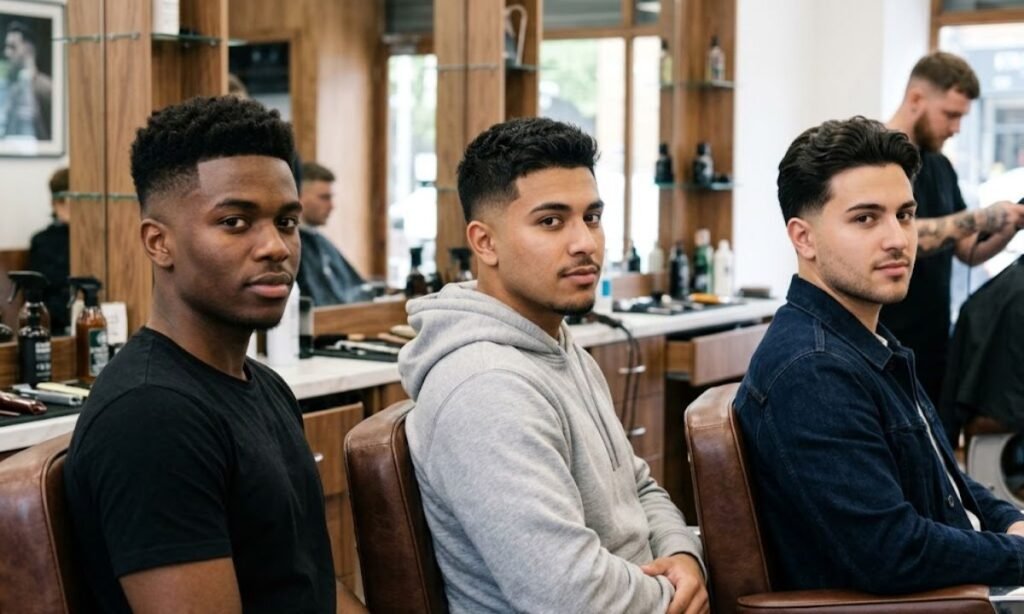
The difference comes down to where the shortest hair starts. A high taper fade begins near the temple, a mid taper fade begins around the ear, and a low taper fade begins just above the ear and neckline.
That one detail changes how bold the haircut looks and how often you’ll need touch ups.
High Taper Fade Versus Mid Taper Fade
The high taper vs mid taper question is mostly about contrast. A high taper gives a bolder look, while a mid taper feels balanced.
If you want your curls to stand out more, go high. If you want something safer, go mid.
High Taper Fade Versus Low Taper Fade
In the high taper vs low taper comparison, the low taper is subtle. It only touches the edges, so the sides keep more weight.
A low taper grows out gracefully and suits office settings, while a high taper is sharper and more modern.
How High Should a Taper Fade Start?
If you ask how high should a taper fade start, the safe answer is around the top of the ear for mid and the temple for high. The best taper height for curly hair depends on your head shape and your density.
Dense coils handle a higher start well, while looser curls often look better a little lower.
How to Choose Between High, Mid, and Low
Here’s a simple rule for how to choose between high, mid, and low taper fades. Think about your lifestyle first and your style second.
If you hate frequent trims, pick low. If you love a sharp look and don’t mind visits, pick high.
If you’re still on the fence, start with a low taper fade as an alternative to a high taper. You can always go higher next time, but you can’t add hair back.
That patience pays off, especially with tight curls that shrink.
How Do You Maintain a High Taper Fade with Curly Hair?

Maintenance has two parts: keeping the fade sharp and keeping the curls healthy. Skip either one and the whole look slips.
The good news is that both are simple once you have a routine.
How Often Should a High Taper Fade Be Touched Up?
Most people need a fade touch-up schedule of every 2 to 3 weeks. A skin fade starts looking fuzzy sooner, sometimes in 10 to 14 days.
That answers how often should a high taper fade be touched up and how long does a high taper fade last: expect around two to three good weeks.
Here’s a basic high taper fade maintenance schedule you can follow:
- Weeks 1 to 2: look at its sharpest, only styling needed
- Weeks 2 to 3: the line-up and fade line maintenance start to matter
- Weeks 3 to 4: book your next visit before the blend turns messy
Barber Visit Frequency and Cost
Cost depends on your city and your barber. In many places a fade runs somewhere between 25 and 50 dollars, with extras for line-ups and specialists.
That means your high taper fade cost per month might land around 50 to 150 dollars depending on how often you go.
The high taper fade versus low taper maintenance math is simple. High fades need more frequent visits, so they cost more over time.
If you want a low-maintenance haircut, a low or mid taper keeps the bill smaller.
Can You Maintain a High Taper Fade at Home?
You can handle small stuff at home, but fixing a fade is hard. Try basic neckline trimming and light cleanup with a trimmer.
Leave the fade blending to your barber, since one wrong pass can ruin a whole side.
If you want to try a DIY fade, start with the neck and sideburns only. Use a guard, move slowly, and never go upward past your starting line.
Those small touch ups stretch time between haircuts.
Curl Care Routine for Healthy Hair
Healthy curls make a fade look better. Stick to a steady curl care routine with cleansing, conditioning, and sealing.
That’s the base of any good curly hair styling plan.
- How often should you co-wash curly hair? Many people do it once or twice a week.
- How often should you shampoo 3C and 4C hair? Usually every one to two weeks, since coily hair dries out easily.
- How to keep curls moisturized? Use a leave-in after every wash, and seal with oil.
- How to prevent dryness in coily hair? Use creams and butters, and limit heat.
That covers co-washing, shampoo frequency, and hair hydration in one go. Add moisture retention habits like a satin pillowcase or bonnet at night.
Your curls will thank you with softer, springier definition.
How to Refresh Curls Between Wash Days
Morning curls often look flat or fuzzy. Mist them with water, add a small amount of leave-in, and scrunch.
That’s the simplest answer to how to refresh curls between wash days and how to maintain curl definition.
For days when you’re short on time, try air-drying curls after a quick mist. A little texture spray adds lift without weight.
Just don’t overdo product, or you’ll invite buildup.
Does a High Taper Fade Reduce Bulk?
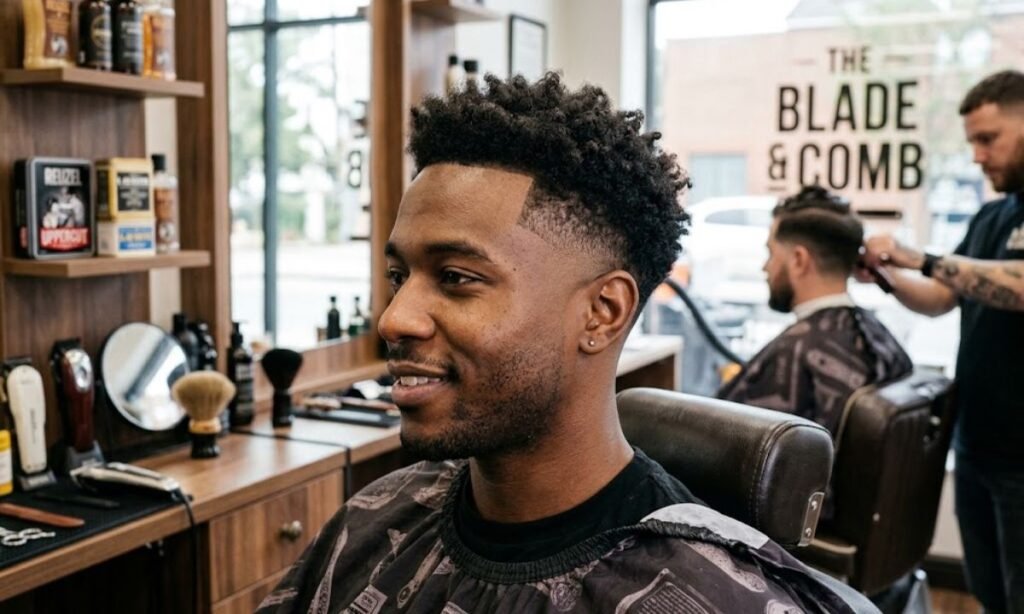
Yes, and that’s one of its biggest perks. Curly hair grows out and up, which makes the sides and back look wide and heavy.
A high taper removes that curly hair density at the sides, so your head looks balanced.
That answers does a high taper fade reduce hair bulk and how to reduce bulk in curly hair. The fade carries the weight away from the ears and neck.
The top then looks fuller by comparison, which is why does a high taper fade make curls look fuller also gets a yes.
To keep the shape even, ask your barber to thin the top lightly if the crown feels heavy. Don’t remove too much, or you’ll lose natural hair volume.
A balanced cut leaves you with voluminous curls that still sit neatly.
Common Mistakes to Avoid
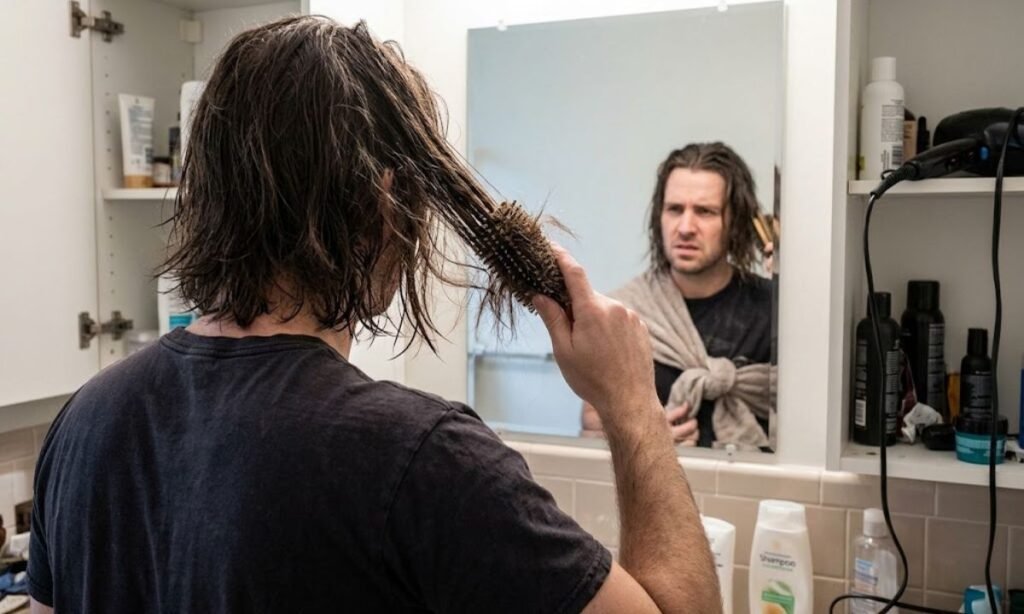
A few small errors cause most bad curly fades. Know them before you sit down and you’ll dodge about 90 percent of the pain.
Here are the ones that come up again and again.
Ignoring Shrinkage
This is mistake number one, and it explains why curly hair looks shorter after cutting. People measure length while the hair is stretched and forget that curls spring back.
Use your shrinkage percentage and share it with your barber.
Cutting Too Short
If you want to avoid cutting curly hair too short, start long and trim in steps. A slightly longer cut always beats a cut you regret.
Tell your barber to leave extra and remove more only if needed.
Letting the Fade Get Patchy
This happens when the fade is uneven or the curls fall over harsh lines. To prevent a patchy fade on curly hair, ask for a smoother blend and use a near-skin finish instead of a hard skin fade.
Dry cutting also lets your barber see weak spots before you leave.
Fixing a Bad Fade
If it’s already gone wrong, don’t panic. Here’s how to fix a bad curly taper fade: wait a few days, see how it grows out, and then book a corrective visit.
Your barber can often blend it back with a short haircut grow-out period and a touch up.
Skipping Product Basics
Diffusing too long, using too much gel, or touching curls while they dry all lead to frizz. Those habits ruin a good cut faster than a bad barber.
Re-read the styling steps above and keep your hands off.
How to Maintain a High Taper Fade in Humid and Dry Weather

Weather changes how curls act. In humid air, hair soaks up moisture and swells. In dry air, it loses moisture and turns brittle.
Both can wreck your look if you don’t adjust.
For how to maintain a high taper fade in humid weather, use a stronger gel and a light anti-frizz serum. Avoid heavy butters that attract more humidity.
A quick spritz of water can bring back shape in the afternoon.
For how to prevent frizz in dry weather, lean on creams and oils that seal moisture in. Wash less often and condition more.
That helps how to protect curls from moisture loss all season long.
You can also checkout this article as well Types of Taper Fade: 14 Styles Every Man Needs to See
Frequently Asked Questions

What is a high taper fade for curly hair?
It’s a haircut where the sides and back fade down high near the temple, while the curls on top stay long and full. It gives strong contrast and suits every curl pattern.
Does a high taper fade work on curly hair?
Yes. It highlights curls by removing side bulk, and it works from 2B to 4C if the barber plans for shrinkage.
How long should my curls be on top?
Divide your desired dry length by one minus your shrinkage. For 2 inches dry with 50 percent shrinkage, aim for about 4 inches stretched.
Should curly hair be cut wet or dry?
Dry is usually better for fades. You see the real length and shape of each curl.
How often should I get a touch up?
Every 2 to 3 weeks for most people, and sooner for a skin fade.
Does a high taper fade suit every face shape?
Yes, if you pick the right top. Choose height for round faces, softness for square faces, and fringe or texture for diamond and heart shapes.
What’s the difference between a taper and a fade?
A taper leaves some length at the shortest point, while a fade goes down to skin. A high taper fade combines both ideas.
Can I do a high taper fade at home?
You can handle neckline trimming, but let a barber do the blend.
Key Takeaways
A high taper fade for curly hair gives you a sharp, modern look without losing your curls. It reduces side bulk and makes the top look fuller.
It works on every curl pattern, from wavy hair to coily hair.
- Plan for shrinkage: measure it and tell your barber the number
- Match the style to your face: height for round, softness for square, texture for diamond and heart
- Cut it dry: you’ll see the real shape and avoid surprises
- Use the right products: light for waves, rich for coils
- Book on time: every 2 to 3 weeks keeps the fade sharp
Now it’s your turn. Which of the 25 styles would you try first?
Drop your curl pattern and your favorite style in the comments, and share this guide with a friend who’s tired of bad fades.
